Tuesday, January 12, 2016

Mixed Messages (Horizon)


This is an updated version of an article which appeared in another Bauer Media magazine a few months ago.

Thursday, January 7, 2016

Gardens of Splendor (En Voyage)

Visitors who tour Taiwan quickly realize it is both densely populated and stunningly mountainous. However, few outsiders know that mid- and high-elevation forests dominated by hardwoods occupy a third of the island, and that other large areas are covered by conifers, softwoods or bamboo. As a proportion of its total land area - almost 59 percent - Taiwan has twice as much forest as Norway.

Understanding what goes on in these arboreal realms, and educating the public about the ecological role of woodlands, is the job of the government’s Taiwan Forestry Research Institute. Of the eight botanical gardens managed by the institute, five were established during the early years of Japan’s 1895-1945 colonial rule of Taiwan. The best known and most accessible of these is just 2km south of Taipei Main Railway Station, and within 20 minutes' walk of Wanhua.

Taipei Botanical Garden has been a research center since 1896, and a place where the public can immerse themselves in nature since 1921. As Taiwan’s capital has grown outward and upward, this 8.2-hectare enclave has held fast as a biodiversity hotspot.

The garden is divided into almost 30 themed zones, and several of the categories will not surprise those who know something about plants and trees. One zone is given over to aquatic plants, another to gymnosperms (whose seeds are not enclosed in fruit), and a third to palmae (palm trees). More unusual is the collection of trees, flowers and herbs mentioned in great works of Chinese literature. Because the Chinese language abounds in homophones, writers have often used plants as emblems. For example, the willow tree (柳, liu) is a symbol of wanting a person to stay (留, also liu). Another section displays plants associated with the twelve animals of the Chinese zodiac. Because the garden’s avians have become used to humans, Taiwan’s bird-photography fraternity is out in force here every weekend. 

As the crow flies, Fushan Botanical Garden is just 33km from Taipei 101. However, because there is no road from the Taipei side, visitors must come through Yilan County’s Yuanshan Township. No buses go near the entrance, and the road is sometimes closed after typhoons. In addition to driving themselves to the garden, visitors must also apply for permission to enter well in advance. The daily limit for tourists is 500 on weekdays, 600 on weekends and holidays. The garden's 409.5 hectares are 600 to 800 meters above sea level. The climate is therefore cooler and wetter than downtown Taipei’s. Mist is common; visitors should bring umbrellas or rainproof jackets, even if the capital is bone dry.

Inside Fushan, as in most of Taiwan’s botanical gardens, the labels attached to plants and trees usually provide the Chinese and scientific names only. To get more out of a tour, visitors should carry a field guide, or stop frequently so they can google names on their smartphones. 

According to TFRI, Fushan is home to 515 plant species. Some are far from rare, such as the nettle Taiwanese people call “biting people cat” (Urtica thunbergiana), and Japanese Holly-Grape (Mahonia japonica). The seeds, roots and stems of the latter are used in traditional medicine. Several trees’ scientific names reveal their local origins. One is Phoebe formosana, sometimes called the Taiwan Phoebe. Another is Quercus tarokoensis (the Taroko Oak), which is native to mid-level mountain areas near Taroko Gorge. A third is a kind of laurel, Litsea morrisonensis, named for Mount Morrison. That peak, the highest in Taiwan, is now better known as Mount Jade. 

The green fingered will adore all of this flora, but for others, Fushan’s real stars are its insects, which include a dazzling array of crane flies, dragonflies, robber flies, weevils, and other beetles. 

Because Fushan is far from major human settlements, the area has a sizable animal population. Mammal activity peaks around dawn and dusk, yet tourists - who are only allowed in between 9 a.m. and 4 p.m. - may well glimpse a Formosan macaque, or perhaps even a Reeves’s Muntjac. The former is Taiwan’s only monkey species. The latter is a small deer which yaps like a dog.

Only the luckiest outsiders get to see other creatures, but evidence of nighttime visits by pangolins and wild boars is everywhere. The former scratch out basketball-sized holes while seeking ants and termites. The latter dig up large areas of topsoil while hunting for the long worms they like to feed on. 

Residents of Taichung and Chiayi are fortunate to have botanical gardens on their doorsteps.  Taichung Botanical Garden is managed by, and located a stone’s throw from, the National Museum of Natural Science. More than 700 plant species are crammed within its 4.5 hectares. The garden’s highlight is undoubtedly the Tropical Rainforest Conservatory. This is no bland conventional greenhouse, but a striking marquee-shaped steel-and-glass structure 31m high and 56m in diameter. Remarkably, it contains a waterfall and a small creek. In addition to retaining warmth and moisture, the building’s shell traps flowery scents which in turn attract butterflies. 

The small city of Chiayi has two TFRI-run sites. Beizihtou Botanical Garden is popular with birdwatchers but gets few other visitors, despite having such curiosities as Garcinia subelliptica and Canaga odorata. The first, also known as the Happiness Tree, bears a fruit resembling the satsuma and related to the mangosteen, but which does not taste nearly as pleasant as either. In Japan and Taiwan, this tree’s leaves have traditionally been used to produce a yellowish dye. In Chinese as well as English, the second is often called “the perfume tree.” If you stand downwind of this fast growing evergreen, a pleasant fragrance is quite noticeable.

Chiayi Arboretum - nearly twice the size of Beizihtou at 8.3 hectares - fills with strolling families and joggers on weekends. In the first few decades of the 20th century, when rubber was considered a strategic material, both sites served as experimental rubber plantations. Nowadays the arboretum is home to an impressive range of tree species, including teak and mahogany trees more usually seen in Southeast Asia or Central America. Here, as in all of Taiwan’s botanical gardens, it pays to pause from time to time, and gaze closely at the surrounding foliage. You are sure to see something you would otherwise have missed: An unusual dragonfly, a parasitic flower, or perhaps a patch of fungus. Some little marvel that, for a few moments at least, will wash away your stress, and convince you these verdant enclaves are not just free, but also priceless. 

This is a shortened and modified version of the article which appears in the January issue of EVA's inflight magazine. This link will take you to the first page of the article as it appears in the magazine's online edition. I took both of the photos here; the first shows a moth in Beizihtou, the second is of Hapen Creek in Fushan.

Tuesday, December 22, 2015

A few thoughts on Tsu.co

I've signed up for Tsu.co, a social network which aims to break Facebook's near-monopoly on this facet of the Internet. The main difference between the two is that Tsu.co gives users a share of the advertising revenue the site generates (there are of course various catches, the main one being you won't see a cent until you've made US$100). What's more, users who get others to sign up receive a sliver of their friends' future earnings from the site. So I'm not being entirely selfless when I say, if you wish to register, you're most welcome to do so using my membership: http://www.tsu.co/StevenCrook

So far, I've done nothing more than post dozens of photos which otherwise will never see the light of day, among them the image here, which shows coins left at the feet of a statue of Mona Rudao in Wushe, Nantou County, central Taiwan. I've also posted pictures from trips in recent years to the UK, the Netherlands, Thailand, South Korea, and Poland.


The main drawbacks of Tsu.co compared to Facebook are that there are far fewer groups (so less chance you'll find a consistently interesting niche), and few people leave substantial comments on photos, articles or links. But you will find a shed-load of gorgeous images.


UPDATE: As you probably heard, Tsu.co closed down last year - before I'd earned more than 50 cents American...

Friday, December 11, 2015

Quoted on Forbes.com

Forbes' Taipei-based columnist Ralph Jennings quotes me in this piece, in which he looks at five indicators which suggest Taiwan could do a lot better. Among his criteria is the lack of greenery in urban areas, a topic I've touched on more than once, in articles such as this one from 2011. 
The photo here, which I think I took in Chiayi City several years back, shows copperpod trees (Peltophorum inerme). The species isn't native to Taiwan, but is common in several parts of Southeast Asia.

Tuesday, December 8, 2015

First travel-writing workshop under my belt

As I write on the blog I've created for these events, pretty much everything relating to my first travel writing and freelancing workshop went to plan. 

Of the ten spaces I made available, nine were filled within a fortnight of announcing the event, and the tenth soon thereafter. One person had to drop out for personal reasons, so I had nine paying customers listening to me, and often chipping in with interesting points or sensible questions. I just hope future audiences are this intelligent and amenable!

Monday, December 7, 2015

Uncontained Potential (Taiwan Review)

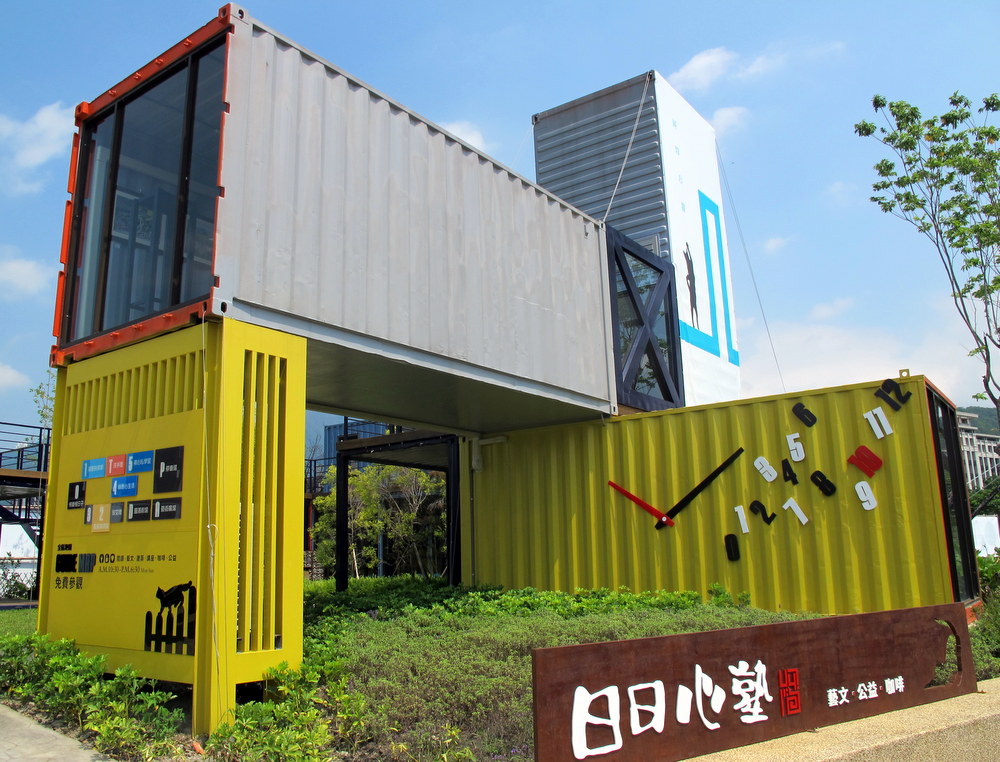
Of the world’s 20-million-plus intermodal shipping containers, around 60 are sited, more or less permanently, along the southernmost stretch of Highway 19A in southern Taiwan, between Tainan City’s Xinhua District and Kaohsiung City’s Gangshan District. None of these steel boxes are being used for their original purpose, which is to hold and protect cargo as it is transported from one place to another by ship, train or truck.

Several have been placed next to pineapple fields, and likely belong to farmers who use them to store agricultural equipment. Some have been extensively modified, with holes cut in the sides for doors, windows and air-conditioning units. These serve as offices for small businesses or accommodate betel nut vendors. The function of others is less obvious, but for sure most will never again see the ocean. Few things are less glamorous than an old freight container retired to the countryside and used as a kiosk. Yet Taiwan has a growing circle of architects and specialist builders who find the possibilities offered by containers much more exciting than any chance to attach their name to a big-ticket landmark.

“In my experience, the general public is quite open-minded about the use of containers as buildings,” says Lin Chih-feng, a Kaohsiung-based architect who has worked on several container-building projects. The social media buzz that accompanied the opening of Flyin’ Moose, a Kaohsiung gastro-pub Lin constructed according to the owners’ design concept early this year, seems to support his claim.

The restaurant’s main structure consists of six 40-foot-long (12.19-meter-long) containers, arranged to create indoor and outdoor eating areas. Standard containers are either 20 feet (6.1 meters) or 40 feet in length, 8 feet (2.44 meters) wide and usually 8 feet 6 inches (2.59 meters) high. “Containers can be utilized in various ways that are very interesting to imagine, but I’m still waiting for opportunities to turn some of my ideas into reality,” Lin says.

His passion for what some call “cargotecture” dates from his participation in the 2013 Kaohsiung International Container Arts Festival, the theme for which was using containers as habitable spaces. Working with Wang Chi-tsun, another Kaohsiung-based architect fascinated by the potential of containers, Lin devised a three-story dwelling with a 6-square-meter footprint. The duo’s contribution used four 20-foot containers. “The first floor comprised the living room, kitchen and bathroom. The second floor held the master bedroom and a kid’s room. The third floor could be used as a study,” Lin explains.

Of the various container buildings Lin has created, the one he is most proud of is located in Kaohsiung’s Pier-2 Art Center, a waterside cultural complex. Incorporating a dozen 40-foot containers, the NT$7 million (US$225,800) building serves as a waiting room for people about to board a tourist yacht. From the observatory atop two vertically positioned containers, visitors can enjoy views of the harbor and ocean.

Having been developed not to slide off ships as they pitch in heavy seas, intermodal containers are exceptionally stable. When fully loaded, they are robust enough to be stacked, one on top of each other, nine high.

Lin points out that since his building at Pier-2 opened to the public in April, Taiwan has endured several tremors and two strong typhoons. “The structure has come through these severe tests safe and sound. This proves container buildings are tough,” he says.

“In earthquakes, you’re safer in a container than you are in a conventional RC [reinforced concrete] building,” asserts Wang, who has been intrigued by containers since his youth. His father, who now works with him, spent a good part of his life as an ironsmith. During that period, the elder Wang was often tasked with dismantling old shipping containers. He used to lament that if only he had the right tools and skills, he would have been able to convert one into a durable and attractive dwelling.

Container buildings are by their nature robust enough to satisfy the structural strength regulations in Taiwan’s building code. They are usually small enough not to require fire safety certification. However, the rule that all new public facilities and business premises allow barrier-free access for the disabled adds substantial costs...

To read the rest of this article, click here. I took the three photos here at a 35-container structure in Taipei City's Beitou District which was assembled to promote a new apartment complex.

Tuesday, November 17, 2015

Paiwan cuisine and Paiwan art: Qiu Yue's Restaurant in Sandimen (Travel in Taiwan)

For some years, Sandimen in Pingtung County has been known as an excellent place to seek out and purchase art works and handicrafts produced by Taiwan’s indigenous Austronesian minority. A bastion of the Paiwan tribe, this compact hillside town is home to artists and artisans who work with wood, stone, leather, fabric and other materials. It's also a great place for sampling aboriginal culinary specialties.

The Paiwan number almost 98,000; the tribe is Taiwan’s second largest aboriginal ethnic group. Sandimen can be considered the northwestern outpost of the Paiwan, who also inhabit townships in Taitung County, on the other side of the Central Mountain Range. Reaching the busiest part of the township involves a short but steep drive up from Shuimen, a lowlands community separated from the mountains by the Ailiao River.

Many tourists park, then browse the souvenir shops which line the main road. A few may wander into the backstreets, where they’ll hopefully follow the bilingual signs to, or simply stumble across, Sha Tao Zazurite Art Studio. In addition to being one of the area’s best glass-bead workshops, this store is the home base of a renowned indigenous dance troupe.

If visitors feel hungry, there’s a good chance they’ll buy a portion of sliced pork or some sausages from one of the town’s stone-barbecue stands. Rather than cook on a metal grill over charcoal, these vendors place choice cuts on a slate slab heated from beneath. Because the juices don’t immediately drain off, the meat is basted as well as roasted. For hardcore carnivores, the results are exquisite.

Visitors who like to head beyond Sandimen toward breathtakingly scenic Wutai know there’s a better eating option a minute or two further along Highway 24, the road which links these two indigenous townships to Freeway 3 and Pingtung City. It’s called Qiu Yue’s Restaurant, and in keeping with the township’s creative leanings, it was originally an artist’s workshop. Located just inland of the km24 marker, Qiu Yue’s takes its name from and is managed by Ms. Li Qiu-yue. Surprisingly, given the role she plays in the local community, Ms. Li isn’t Paiwan. She’s not even an aborigine. Like approximately four-fifths of Taiwan’s population, she’s a descendant of migrants from mainland China’s Fujian province. In addition to being an industrious promoter of local culture and a gracious host, Ms. Li is the wife of a prominent Paiwan carver-illustrator, and the mother of an up-and-coming artist.

Her husband is Sakuliu Pavavalung. If that name seems very different to others you’ve come across while reading about Taiwan, it’s because it’s a true Austronesian name. Sakuliu means “arrowhead” in Paiwan. The majority of native people still use the Han Chinese surnames foisted by the authorities onto their parents or grandparents soon after World War II. Sakuliu, however, is one of a growing number of aborigines who’ve taken advantage of a special law to “fully restore” his tribal name. A parallel movement is demanding that certain Austronesian place names be restored.

Sakuliu, a man of many talents, created many of the decorations which now adorn the restaurant. Among them is a set of alluringly asymmetrical chairs he made two decades ago. Each is hybrid of iron and wood, but the blend of materials is isn’t so much an artistic statement as a reflection of that period’s economic realities. “Back then, iron was cheaper than now, and the government was very strict about people taking large pieces of wood out of the forests,” Ms. Li explains.

A master potter to boot, Sakuliu can often be seen at the restaurant, when work isn’t calling him to other parts of Taiwan. These days he’s much in demand. If you’ve flown between Taiwan and New Zealand recently, you may well have come very close to one of his largest works...

To read the rest of the article, which includes a description of some of the dishes on the menu and the restaurant's address, click here - or pick up the November/December issue from a visitor information center.