Friday, February 1, 2013

Homes away from home (Taiwan Review)

When Charlies Liu quit his civil service job with the Kaohsiung City Government and returned to the place where he grew up so he could be with his ailing mother, he did not think he would soon be embarking on a new career in the tourism industry, and that within a decade he would have hosted visitors from more than 40 countries.

In November 2003, on land that has belonged to his family for more than 80 years, Liu opened Small Swiss Homestay, a lodging establishment with four rooms and mountain views. Located in a tea-growing district in Chiayi County, southern Taiwan, not far from Alishan National Forest Recreation Area, Small Swiss Homestay is in many ways a typical minsu, as bed-and-breakfast (B&B) establishments are known in Chinese.

Over the past decade, Taiwan’s tourism industry has transformed significantly. Perhaps few of the changes have enhanced the travel experience more than the proliferation of minsu. In these small lodges, guests can stay in a family-run establishment and enjoy a blend of informal hospitality, local knowledge and natural scenery that few hotels can match. Liu, for instance, takes many of his guests to Fenqihu, a nearby town famous for its quaint character, and Yushan National Park, where they can see Taiwan’s highest peak.

Until December 2001, when the Regulations for the Management of Home Stay Facilities were issued, minsu existed without a legal framework. The regulations define “a home stay facility” as “a lodging facility run as a family sideline business, using the spare rooms of a self-used residence to provide tourists with a rural living experience.” 

In practice, while many homestay businesses match these criteria closely, quite a number are purpose-built accommodations that provide the family’s main source of income. Most of these latter establishments are fairly modest, though, and retain the personalized service of a family-run business. The rules state that such operations should have “no more than five guest rooms, with a total floor area of no more than 150 square meters,” although local governments can authorize up to 15 rooms for homestays with “specific tourism features” such as those located on a tourist farm or in a remote area.

To be licensed, a B&B must satisfy fire safety rules and undergo inspections that check, among other things, whether each “guest room and bathroom [has] adequate ventilation and ... sufficient light,” according to the website of the Tourism Bureau under the Ministry of Transportation and Communications. Operators must purchase insurance, and cannot be individuals with convictions for drug, firearm-related, sexual or other serious criminal offenses.

Since the regulations came into force, the number of fully licensed establishments has been growing nonstop. According to statistics issued by the Tourism Bureau, new minsu registered with the authorities at a rate of more than one per day between 2004 and 2008.

“At the end of September 2012, the national total of legal B&Bs was 3,619,” says Chen Yu-chuan, director of the bureau’s Hotel Inspection and Supervision Center. This central government unit oversees Taiwan’s homestay industry, but local governments are responsible for day-to-day enforcement. “City and county governments do from time to time, in accordance with the provisions, carry out inspections of B&Bs,” Chen says, adding that violations, such as a lack of firefighting equipment, are dealt with as dictated by the law.

“The Tourism Bureau offers operators of legal B&Bs guidance so they can upgrade their services. The bureau has also held many business management classes, and granted money to local governments and industry associations so they can organize workshops,” Chen says... 

The entire article, which appears in the February edition of Taiwan Review, can be read online. 

Thursday, January 24, 2013

Fengshan's Divine Magistrate (Culture.tw)

The Chinese folk pantheon is massive, and includes many deities said to have once been ordinary mortals. Most of these personalities - Mazu is an excellent example – are semi-legendary, and are believed to have spent their human lives on the Chinese mainland.
 
Some, however, undoubtedly existed, and spent all or part of their lives in Taiwan. Zhu Yi-gui is one. Born in Fujian, he migrated to Taiwan in 1713. While earning a living as a duck farmer in south Taiwan, he led an uprising against the Qing Empire in 1720. The rebellion collapsed and he was put to death, but he is now worshipped as one of a trinity of city gods in Tainan's Xiaonan Chenghuang Temple.


The likes of Zhu Yi-gui are commemorated because in their lifetimes they displayed great wisdom, righteousness or kindness. These are not qualities often associated with politicians and government officials, many of whom are regarded as self-serving and vain. So if a government appointee is still revered more than 150 years after his death in one of the places where he held office, he must have been an exceptional individual.
 

Cao Jin seems to have been such a man. A Qing Dynasty scholar-bureaucrat, he was born in what is now Qinyang City in Henan Province  in central China. Cao was already 51 years old when he arrived in 1837 in what these days is Kaohsiung City's Fengshan District in 1837. At that time, it was the administrative headquarters of Fengshan County, Taiwan still being part of Fujian Province and divided into four local government units. Cao’s position as Fengshan County magistrate gave him power over and responsibility for an area more or less equivalent to today’s Kaohsiung City and Pingtung County. 

Like other parts of Taiwan, Fengshan County had a lot of land that would have been ideal for farming if only water supplies were reliable. Realizing this, Cao ordered the digging of a 9km-long irrigation canal between the waterway now called the Gaoping River, but then known as the Xiadanshui River. Work began in the winter of 1838 and took two years.

Although the Industrial Revolution was in full swing in the West - and it is said steam engines were used in China back in the Han Dynasty (206BC-220AD) - all the work was done by hand. Some 44 branch canals were also dug, and together they provided water to around 2550 jia of arable land, equal to 2,473 hectares. Even before it had been completed, Taiwan’s governing prefect, Xiong Yi-ben, decided to rename the waterway the Cao Gong Canal to celebrate the magistrate’s achievement. Cao Gong can be translated as “the honorable Mr. Cao.”

Intact sections of the canal can be found near Fengshan Railway Station. In recent years, the waterway has been tidied up. It is now a lovely place to stroll, and a fitting memorial to the magistrate. Look into the waters and you will see lots of fish, a few turtles and some frogs.

The Fengshan area was not the first part of Taiwan to have its fortunes transformed by irrigation works. Lugang was founded in the mid-17th century, but did not grow rapidly until after the completion in 1719 of a huge privately-financed irrigation system in its hinterland. Rice output rose dramatically, providing the surpluses which the town’s merchants exported to Fujian. Nor was it the last. The inhabitants of the Chianan Plain had to wait until the 1930s, when Hatta Yoichi (1886-1942) masterminded the construction of Wushantou Reservoir and a network of channels and ditches which converted more than 100,000 hectares of drought-prone, malaria-stricken land in Taiwan’s southwest into highly productive farmland generating three rice crops per year.

Cao Gong’s contribution to Taiwan’s development is not as well known as Hatta’s, but in Fengshan at least he is far from forgotten. Less than 500m from Fengshan Railway Station, a medium-sized house of worship is dedicated to his memory. Cao Gong Temple stands on Cao Gong Road; the school on the other side of the road is named Cao Gong Elementary School.

From the outside, Cao Gong Temple is little different to a thousand other shrines in Taiwan. Established in 1860 - 11 years after Cao’s death, and 15 years after he left his final Taiwan posting in Danshui (淡水) - it was totally rebuilt in 1992. The effigy of Cao on the main altar is no bigger than a child’s doll. Every summer, memorial ceremonies are held here on the 15th day of the eighth month on the lunar calendar. Inside the temple there are four-character inscribed boards presented in recent years by representatives of Cao’s hometown on the Chinese mainland. More interesting are the black-and-white photos which show how the canal looked a few generations ago, and the Chinese-only timeline of Cao’s life.

Cao Gong Elementary School boasts an ancient and gnarled bishopwood tree that was planted as a memorial to the official sometime after his death (no one is sure precisely when). During weekends and school holidays, outsiders are free to enter the campus via the gate on Fengming Street to look at what is called the Cao Gong Giant Tree. At other times, if you set foot in the school’s grounds you risk annoying the security guard. 

Fengshan has other relics within walking distance of the railway station. Two can be found if you go a little further east along Fengming Street. Fengyi Chenghuang Temple at no. 66 is one of the district’s three historic houses of worship; the others are Cao Gong Temple and Longshan Temple. Fengyi Chenghuang Temple was founded in what is now called Kaohsiung City’s Zuoying District, back when that place was called Fengshan and served as the headquarters of Fengshan County. After a rebel army led by Lin Shuang-wen captured old Fengshan in the late 1780s, the Qing court decided to relocate the county offices to the southeast. The city-god deity was moved at the same time, and the temple reestablished.

Adjacent to the temple, Fengyi Tutorial Academy was built in 1814 as a school where young men could study the classics and prepare for imperial civil-service examinations. The complex has 37 rooms, but has long been closed for much-needed renovations.

Fengshan’s Longshan Temple is not as well known as the houses of worship that share its name in Lugang and Wanhua. Nonetheless, it is worth visiting on account of the delicate carvings and paintings inside. If the temple is your last stop, the most convenient way of returning to downtown Kaohsiung or Zuoying High-Speed Railway Station is to take the KMRT’s Orange Line from Dadong Station.

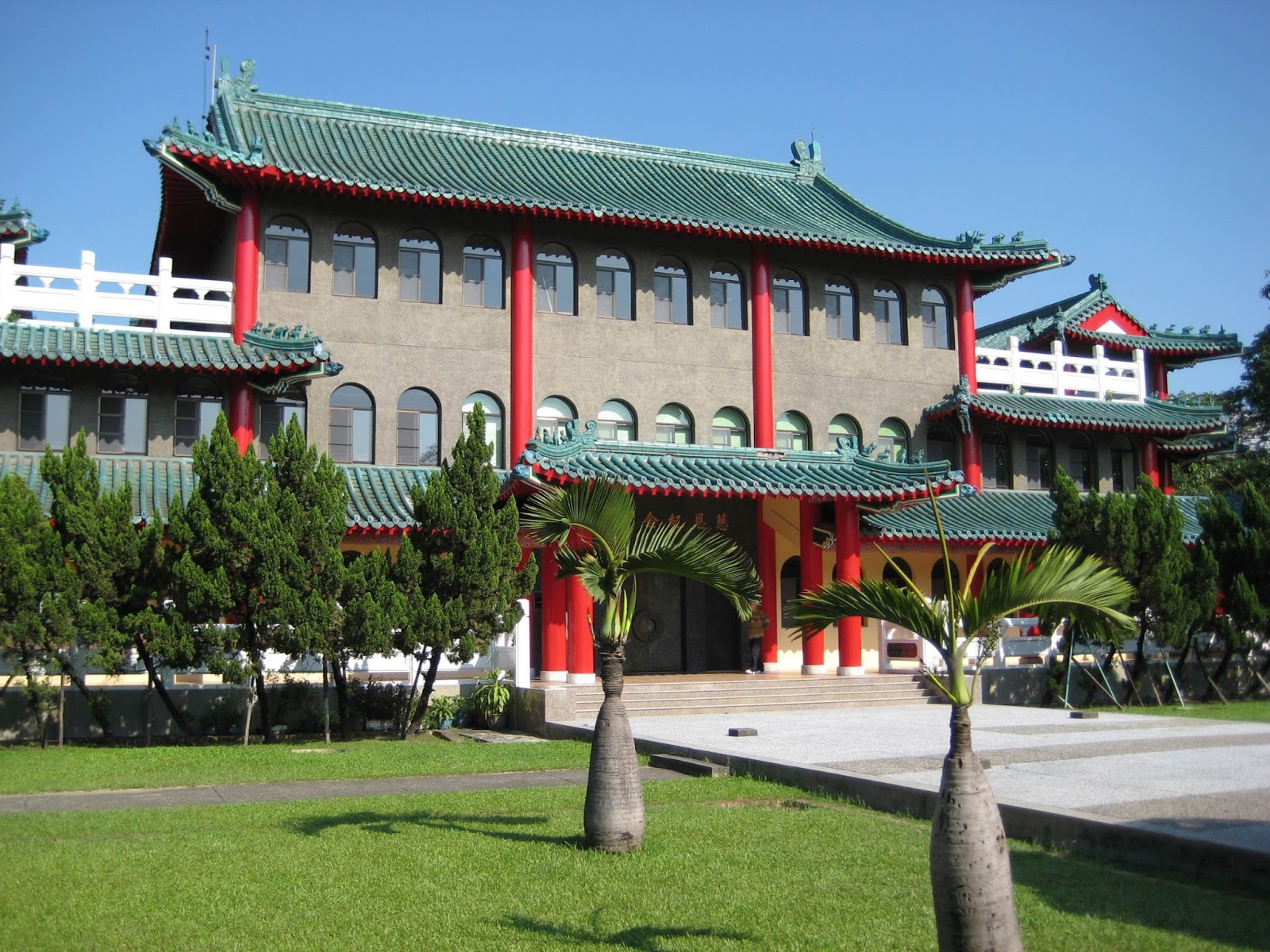
This article was originally published on Culture.TW, a website sponsored by Taiwan's central government. As it's no longer online, I've posted the whole thing here. The photo shows a library in Fengshan.


Tuesday, January 22, 2013

Prayers and Flames: The Burning of the King Boat (Travel in Taiwan)

Taiwan wasn’t always the safe, healthy place it is today. Until the early 20th century, malaria was a constant threat and cholera epidemics were frequent. Lacking medical knowledge and influenced by traditions they’d brought from mainland China’s Fujian province, Taiwanese of Han descent lived in fear of plague-spreading demons. Naturally, they sought divine protection from these malevolent spirits, whom they called Wang Ye (王爺), or "royal lords."

The moment the King Ship left Donglong Temple (東隆宮), the exodus began. The vessel wouldn’t be set afire for at least three hours, but Taiwan’s most famous conflagration happens only once every three years, so we wanted to snag a good spot. Judging by the crowd that swept us through Donggang’s (東港) narrow streets, everyone else had the same idea.

Getting to the burning site was more like a mass escape than a religious parade. Because the crowd was so dense, I found myself taking short, shuffling steps. Every few minutes, we were jostled aside so a deity-bearing palanquin, or a team carrying one of the ship’s masts, could pass. But at the beach we got clear views as the sails were unfurled and the anchors raised. Then a king’s ransom in "spirit money" (yellow paper rectangles especially made for burning during folk religion ceremonies) was piled around the hull. Finally, volunteers laid long strings of firecrackers across this mountain of combustible material...


When the whole article is online, I'll post a link here. I blogged about this festival late last year.

Monday, January 21, 2013

Taro Town (Travel in Taiwan)

Thanks to Taiwan’s fabulously diverse landscape and climatic variations, the country’s farmers are able to grow almost every kind of fruit and vegetable, including many which aren’t native to the island.

If you’ve spent your life in cool climes, you’d be excused for not knowing what taros (芋頭, yutou) and sweet potatoes (番薯, fanshu in Mandarin; also known as 地瓜, digua) look like, or how they taste. Every Taiwanese can tell you in some detail how taros differ from sweet potatoes, however, and not only because they grew up eating them. The Chinese names of these root vegetables are cultural code words: “Sweet potato” is shorthand for a Taiwanese person whose ancestors came to this island several generations back, while a “taro” is someone who (or whose parents) arrived after 1945.


The taro has its origins in Southeast Asia, but these days is grown on a significant scale from Nigeria in the west and Polynesia in the east. No one knows when taros were first cultivated in Taiwan (long before 1945, that’s for sure), but there’s no doubt which part of the island can claim to be the Republic of China’s taro capital: Dajia (大甲區), a bustling town of almost 80,000 people which is part of Taichung City.


Downtown Dajia, just 6km from the ocean, is home to one of Taiwan’s preeminent places of worship, Jenn Lann Temple (鎮瀾宮)...


The rest of this article, which appears in the January/February issue of the magazine, can be read here.

Sunday, November 18, 2012

Jiadong: Awash in Hakka Heritage (Culture.tw)

Jiadong in Pingtung County (屏東縣佳冬鄉) has never been an important place. A much-used road between Kaohsiung and Kenting National Park runs right through it, yet few people stop here. Its architectural and historical treasures have been written about in specialist books and magazines, but they've not won much attention compared to similar attractions like the Lin Family Gardens (林家花園).

Much of Taiwan was originally inhabited by aborigines of Austronesian descent, and in Jiadong's case the natives were members of the Makatao tribe. Their name for this place was Cattea, and the Han Chinese migrants who began arriving in this area in the 1650s used a name derived from that toponym, Katang (茄苳). During the reign of Emperor Kangxi (1661-1722), Hakka people began to settle in the vicinity of Jiadong. Soon they were playing a role in Taiwan's history: Many Jiadong Hakka joined the “Left Unit” (左堆) of the Liudui (六堆) militia, a loyalist grouping of Hakka neighborhood-defense bands which helped the Qing Empire regain control of Taiwan at the end of the Zhu Yi-gui Incident (朱一貴事件) of 1720-21.

The best-known Hakka landmark in Jiadong is the Hsiao Family Residence (蕭家古厝). A grade-three national relic since 1985, the house was restored between 1994 and 2003. Situated in the heart of Jiadong, it is open to the public from Tuesday to Sunday 9am until midday and 1pm to 5pm. On weekdays, visitors are advised to call 0932-200-024 in advance to ensure somebody will be there to unlock the front door, as only the rearmost portion of the complex is still lived in. Admission is NT$50 for adults and NT$30 for children.

Visitors are sometimes greeted and shown around by Hsiao Chia-hsiung (蕭嘉雄). A sixth-generation descendant of the first Hsiao to set foot in Taiwan, he told us his forebears settled first in Tainan, then Taiwan's administrative capital, and that the second and third generations grew wealthy making wine and dyeing cloth. The Hsiaos – who can trace their lineage back 24 generations, to Jiangxi Province on the Chinese mainland – became major landowners in Jiadong. According to Mr. Hsiao, the township was once 80-percent Hakka, but because of population movement, the ratio of Hakka people to those of Minnan (Hoklo) descent is now about 1:1.

Work on the Hsiao Family Residence [pictured right] began more than 150 years ago. Many of the craftsmen and much of the wood was brought in from the mainland especially for the job. Over the following four decades, the complex was expanded bit by bit until it covered 0.4 hectares. Brick, wattle-and-daub, and round river stones were among the materials used.

The crescent-shaped pond in front of the compound, created for geomantic reasons, was originally more than twice its current size. The only part of the mansion not classically Chinese is the terrazzo facade, added circa 1920 after a severe typhoon damaged the original.

Hexagonal and rectangular entrances connect different parts of the mansion. These are deliberately unaligned, as it was believed that having one doorway facing another was like setting one person's mouth in opposition to the mouth of another, and would lead to arguments among the residents.

There are almost as many cat-flaps as actual doors. Although they were not cherished as pets in the modern sense, the mansion's cats enjoyed access to every part of the compound because they helped keep the rat population in check.

Several clan members living in Tainan relocated to Jiadong during the early years of the Japanese occupation (which lasted from 1895 to 1945), so for a period the compound housed more than 100 people. In many cases, children shared a single room with their parents, the youngsters sleeping on a wooden platform above their parents' bed.

Few of the rooms and artifacts are labeled in English, but in many cases the function is obvious. The kitchen is surprisingly spacious, and has its own well. The adjacent storeroom, Mr. Hsiao told us, was where female members of the family killed time by gambling. Carved fragments of wood – presumably original parts of the building, retrieved when the house was renovated – lie stacked on shelves, but none are labeled and nothing stops visitors from handling them. Those who do not read Chinese are unlikely to guess the function of the huge ceramic pot in the hallway: It served as a one-person air-raid shelter during World War II.

Elsewhere, there are antiques and old garments, plus scores of photographs. These images show the Jiadong of yore, the house as it looked decades ago, and long-deceased members of the Hsiao family. One clansman married an Atayal woman; her portrait shows that, like many of her fellow tribeswomen, she had a tattooed face.

One of the five halls continues to serve as the clan's ancestor shrine. Noticing that several names on the main memorial tablet were covered by tiny strips of paper – and wondering if they represented family members “cast out” after doing something unpardonable – we asked Mr. Hsiao to explain. It turned out his name is one of those covered up; when the tablet was carved some years ago, he told us, every member of the fifth and sixth generation was included. Those still in the land of the living have their names obscured; when a death occurs, the relevant strip of paper (originally red, but most have faded to white) is removed, “adding” that person to the tablet.

In 1930, members of the family built a three-story Western style building on an adjacent plot of land east of the original mansion. That structure, called the Hsiao Family Western House (蕭家洋樓), is no longer safe to enter, yet alone fit to live in.

Like Anping in Tainan, Jiadong has plenty of characterful yet unheralded old buildings. One, at 111 Gouzhu Road (溝渚路), has a superb brick entrance [pictured top] and several fine wall decorations.

Jiadong's other major attraction is located on the northwestern edge of the town. The Yang Clan Shrine (楊氏宗祠, pictured left), another grade-three national relic, almost fell victim to the wrecker's ball. In 1995, when the government announced plans to demolish the shrine so a road could be straightened, conservationists and cultural experts declared their support for the site's preservation. Civic groups mobilized public opposition, and the proposal was soon dropped.

A major renovation effort was completed in 2009, just as the shrine marked the 90th anniversary of its founding. Notable features include a lintel with two European men, each down on one knee, bearing the roof on their shoulders. The upward-curving “swallowtails” on the roof are decorated with elephants and dragons. The former symbolize hope that members of the clan can attain the rank of general or ministerial office. Traditionally, the latter are believed to protect buildings against fire.

According to a notice in the shrine, in 2011 the management accepted donations from 59 individuals, nine of whom had surnames other than Yang. The amount given totaled NT$527,200, almost a quarter of that coming from one person.

The shrine looks splendid, but some think it lost part of its charm when renovated. The silver-haired man I met inside – he was surnamed Yang, of course – responded to my compliments about the appearance of the building with a wry smile and the words: “It was more beautiful before.”

Like my recent piece on Yan Hong-sen, this article was commissioned by and paid for by Culture.tw, but not published until December.

Friday, November 9, 2012

Sun Moon Lake - An Enchanting Waterscape (Unity)

When they flooded a basin near Taiwan's geographical center to produce hydroelectricity, little did the Japanese colonial authorities then ruling the island know they were also creating one of Taiwan's most enduring tourist attractions. Two small bodies of water – one called Sun Lake, the other Moon Lake – merged, and gained the name Sun Moon Lake.

For half a century, this sublime expanse of blue surrounded by rugged green mountains has been one of Taiwan's most popular destinations. Many Taiwanese spent their honeymoons here, and the lake's fame has spread beyond Taiwan. For mainland Chinese tourists heading to the island, Sun Moon Lake is a “must see” alongside Taipei 101 and Alishan.

The surface of the lake covers 827 hectares and is 748m above sea level. The waters are around 30m deep. The water level barely changes from summer to winter, so boat excursions are possible year-round. Swimming, however, is permitted just one day per day. One of the most popular ways of seeing the lake is to spend a day cycling all the way around it – the distance (33km) is too long to be comfortably hiked, but ideal even for slow cyclists.

Whether you plan to pedal or ride a motorcycle, it makes sense to start in Shuishe, where electric scooters as well as bicycles and gasoline-powered motorcycles can be rented. The main lakeside settlement also has hotels to suit all budgets, lots of places to eat, as well as a bus station.

Before leaving Shuishe, spend an hour exploring the little finger of land that juts into the lake here. Chiang Kai-shek had a villa on what is called the Hanbi Peninsula. It is long gone, replaced by one of Taiwan's swankiest hotels, but the church where the late president worshiped still stands.

Boat tours, which cost NT$300 for adults and NT$200 for children and seniors, start from Shueishe Wharf (and some other points beside the lake) and last about one-and-a-half hours.

Many of those on two wheels proceed in a clockwise direction and make Wenwu Temple their first stop. This imposing piece of architecture is dedicated to Confucius and has a superb setting. For Western visitors, however, two shrines on the south side of the lake may have more resonance. Xuanguang Temple and Xuanzang Temple – the former is by the water's edge, the latter is 850m away, accessed by a gently sloping pathway – hold relics associated with Xuan Zang, a 7th-century Chinese Buddhist monk revered for traveling to India and translating religious texts. His adventures were retold in a classic Chinese novel, Journey to the West; a 1970s Japanese TV series based on the novel attracted a cult following when shown in English-speaking countries under the title Monkey.

On a hillside nearby stands Cien Pagoda [pictured right]. Built on the orders of Chiang Kai-shek as a memorial to his mother, the top of the pagoda is exactly 1,000m above sea level. Do climb the stairs to better enjoy the scenery.

The Sun Moon Lake Ropeway offers even better views for less physical effort. This 1.87km-long cable car system links the lake with the Formosan Aboriginal Cultural Village, a theme park where indigenous culture is presented in entertaining formats. Tickets combining admission to the village with the ropeway are a good option.

To meet members of Taiwan's indigenous minority in more conventional circumstances, head to Ita Thao, a village across the lake from Shuishe and home to Taiwan's smallest aboriginal tribe. As of spring 2012, the Thao numbered just 722 adults and children. When the water level rose, they were forced to leave their ancestral home, Lalu Island in the lake's western half. However, they continue to revere the islet – now just a tiny speck of land – as the abode of their ancestors' spirits. Non-Thao are barred from setting foot on Lalu Island, but many boat tours sail around it.

Visitors are unlikely to hear Thao being spoken. Nowadays only a few elderly people are able to speak the tribe's traditional Austronesian language proficiently, but activists are trying hard to save the tongue from extinction. The tribe's unique music, built around rhythms pounded out with pestles, is still going strong, and is often performed as part of the song-and-dance shows organized by the resort's major hotels.

The round-the-lake bus service is another way of circumnavigating Sun Moon Lake. Jump on/jump off tickets valid for one day are NT$80. Before each stop, announcements are made in English and Chinese.

Visitors wanting to get to Sun Moon Lake have a number of straightforward options. Motorists can take Freeway 6 inland toward Puli, then follow Highway 21 south. There are direct buses from downtown Taipei and Taichung High-Speed Railway Station. Anyone wanting to add the scenic Jiji Branch Railway to their itinerary can ride it as far as Shuili, then hop aboard a local bus to Shuishe. For more information, visit the website of Sun Moon Lake National Scenic Area Administration.

This is an edited and slightly shortened version of the article which appears in the November/December issue of Unity, the inflight magazine of UNI Air.

Tuesday, October 30, 2012

A private lock collection finds a public home (Culture.tw)

Yan Hong-sen (顏鴻森) has a high-profile day job, and a hobby that has made him the subject of several newspaper and magazine articles. Yan is a university chair professor in mechanical engineering and executive vice president of National Cheng Kung University in Tainan City. Outside academic circles, he is best known for building up a remarkable collection of household objects that few people pay much attention to: Locks, specifically ancient Chinese padlocks.

Yan, who was born in 1951, was in the news again recently when he decided to donate the bulk of his collection to the National Science and Technology Museum in Kaohsiung City. On November 8, the museum will inaugurate a special exhibition of Yan’s locks. These items will then be displayed in other cities before taking up a permanent place in the Power and Machines Exhibition Hall on the NSTM’s second floor.

In September, some of Yan’s locks were displayed at the University of Malaya in Kuala Lumpur - the first time any of them were exhibited overseas. Yan had to politely refuse previous requests to send locks to museums and other places outside the ROC; as an individual without the backing of a major institution, he lacked the time and administrative resources to handle shipping, insurance and other issues.

Between 1986 and 2007, Yan acquired more than 700 locks; media reports describing his collection as numbering more than 900 are simply inaccurate, he says. Although it is not a huge number, the collection is rich in different types and shapes. Some are the only ones of their kind remaining in the world. The oldest is around 2,000 years old, but the majority dates from the Qing dynasty or early 20th century. Not all are being consigned to the museum this year. The 150 currently exhibited in NCKU Museum will stay where they are until November 2014, then head south to Kaohsiung. Yan says he is keeping another 20 at home so he has something to show friends and visitors. However, those will also eventually go to the NSTM.

Yan is confident the NSTM will have one of the world’s great public collections of locks, such as the Locks and Fastenings Gallery of Science Museum in London and Germany’s Deutsches Schloss und Beschlagemuseum at Velbert. Yan has visited both, naturally.

Yan’s desire to collect came long before he knew what kind of thing he would concentrate on. He first pondered the possibility of building a collection in 1977, while studying at the University of Kentucky. His supervisor, Dr. D. C. Tao (陶德昌), had an interest in antique European furniture and let Yan to take a close look at the collection he had built. But such items were way beyond Yan's modest means, so he did nothing to turn his dream into reality.

A couple of years later, Yan’s interest in building a collection was rekindled when his doctoral supervisor at Purdue University, the late Professor Allen S. Hall Jr., showed him the 100-plus weighing scales he had accumulated. It was then that Yan realized: “To be a collector, it isn't necessary to be a millionaire. You just have to identify a good topic.”

By May 1980, Yan had decided that his future collection would have to be mechanical in nature, to fit in with his engineering background, and related to Chinese culture. Moreover, the items should be neither too large, too expensive, nor commonly collected. But years were to pass before Yan's “Eureka!” moment. One day in November 1986, killing time at a vendor’s stall near Taipei Main Railway Station at the end of a business trip, he found a traditional Chinese lock at least 50 years old. Immediately grasping that padlocks met all of his criteria, he purchased the piece.

By mid-1996, Yan had around 350 locks. Few collectors let their children play with the items they so painstakingly located and acquired, but the NCKU executive vice-president says: “For a kid, playing with a lock is like doing a puzzle. I'm not sure what my children learned by playing with the locks, but they did treat them as unusual toys which other kids didn't have.”

After being appointed the founding director of NCKU Museum in November 2007, Yan stopped collecting so as to avoid any possible conflict of interest. No one has ever sought to buy his collection; this, Yan says, is because he has always made it clear that he had no interest in selling his locks, and would donate them when the time and offer were right.

Yan, who feels his main achievement is preserving locks so they can be better understood by future researchers, says: “The real value of a collector isn’t just acquiring, but also researching, finding something new and sharing it.”

For some years, Yan planned to establish his own lock museum. A dozen years ago, he bought a plot of land in what was then Tainan County (now merged with Tainan City) for that purpose. But eventually he concluded a major museum would make a better home for his locks, and began letting it be known that he was willing to give away his entire collection if an institution could meet these conditions: That the locks be researched; and that they be on public display. Yan likens the hunt for a permanent home for his locks to, “making sure your daughter finds a good husband.”

Yan and the NSTM have a long relationship; he served as the museum’s director-general from 2002 to 2004. However, several years elapsed between Yan announcing that he wished to donate his locks to a museum, and agreement being reached with the NSTM. It was in January 2011 that Chen Shiunn-shyang (陳訓祥) - formerly Yan’s deputy at the NSTM and now incumbent director-general - told Yan that one of the museum’s curator positions was about to fall vacant, and that he was willing to appoint a lock specialist to the post if Yan were to commit his collection to the NSTM. Yan readily agreed, and comments: “To have one curator specializing almost full-time in one field is rare in Taiwan’s museums. Most curators have to cover several areas.”

Before Yan began writing papers about his hobby, almost nothing had been published on the subject of ancient Chinese locks. A second edition of his bilingual book The Beauty of Ancient Chinese Locks was published in 2003 by the Ancient Chinese Machinery Cultural Foundation, an organization Yan established with others who share his passion. In one of the book’s many fascinating sections, Yan explains that the keyhole of a lock is often an indication of the original owner's social status: “The shape of the Chinese character 一 [yī] was used by civilians, 士 [shì] was used by the intellectual class, and 吉 [jí] was used by nobles and high-rank officials.”

For some of the locks Yan acquired, simply having the right key does not guarantee quick access. The keyhole may be disguised, or the key and hole so oddly shaped as to create a 3D puzzle.

Yan found locks made of iron, bronze, copper, cupronickel and brass, and even silver. Locks of humble origin are usually wooden rectangles, while those crafted for nobles after Tang dynasty often bear fine engravings and are shaped like musical instruments or animals. Fish-shaped locks were especially popular, Yan explains, because fish sleep with their eyes open, and so were traditionally regarded as symbols of vigilance. Traditional Chinese combination locks do not use numerals like the combination mechanisms on modern suitcases, but rather Chinese characters.

The locks Yan spent years finding will no longer be in his possession, but he expects they will continue to play a major role in his life. He has no intention of ceasing to research, write and lecture about locks, saying emphatically: “This will always be my hobby!”

This article was written for Culture.Tw, a government-sponsored website. I was paid for it very soon after sending it in, but the website wasn't updated for some months and the piece didn't appear until late December. To see the online version, go here. The photos were taken by Sam Li and provided by Yan Hong-sen.